
A cheat sheet for the politically curious practitioner ...
The UK Foreign, Commonwealth and Development Office (FCDO) and the Thinking and Working Politically Community of Practice (TWP-CoP) have been quietly releasing what has become a genuinely useful suite of guidance notes. Six in total, published between 2017 and April 2026, they range from introductory primers to detailed technical tools. Taken together, they represent probably the most comprehensive freely available PEA toolkit from any bilateral donor. Here’s my guided tour (with a little help from Claude1, my new best friend).
Start here if you’re new:
Published back in 2017 by the Stabilisation Unit, this 13-page introduction covers the basics: why power and politics shape development outcomes, what a PEA typically contains, how to navigate the bewildering range of frameworks that exist, without drowning you in theory.
Best for: new development practitioners, programme officers joining a governance or fragile states team for the first time, country office staff who need a quick orientation before a programme design workshop. Also useful for NGO staff who work alongside FCDO on politically complex programmes and want to understand the donor’s analytical language.
The core reference document:
This is the mothership, a 31-page overview published in 2023.
It provides a systematic introduction to applied PEA: what it is, how it should be planned and carried out, and how it relates to the broader “thinking and working politically” agenda.
It frames Political Economy Analysis (PEA) as ‘Not a tool but a way of life’, a one-off deliverable, but as an ongoing analytical habit that should shape programme design, implementation and adaptation. That’s important because so many PEAs are not much more than lucrative gigs for consultants, with the resulting tomes (often largely cut and paste from other PEAs) gathering dust on shelves in donor offices around the world. Alan Whaites, one of the authors, tells me this will be refreshed and re-issued over the summer to bring it up to date, for example by including a new section on using AI in PEA (for everyone who has found a new best friend in Claude).
Best for: Senior advisers, team leaders and programme managers who need a solid conceptual foundation before commissioning or leading a PEA. Also the right starting point for anyone mentoring junior staff on governance analysis. Think of it as the textbook; the other guides are the practicals.
When you’re in a hurry:
Published in September 2025, this four-page technical note is for when you don’t have months to commission a full PEA but still need to understand the political landscape before making decisions. It simplifies a popular PEA tool - structure-agency thinking - into something any development practitioner can apply wherever they’re working, even without specialist training.
Best for: Programme implementers in the field who need to make rapid decisions, short-term advisers on scoping missions, or teams who need to do a quick political temperature check before a policy dialogue. Particularly good for non-governance specialists - health, education, climate - who want to do better contextual thinking without becoming overnight political scientists.
Knowing who’s who and how they connect:
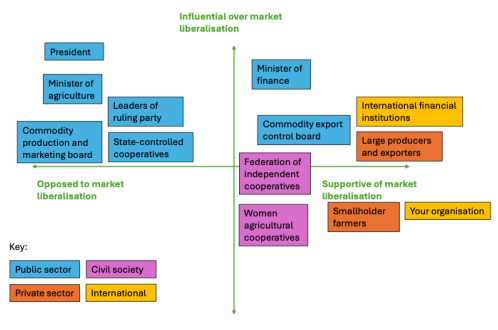
The newest addition to the series (April 2026). At 31 pages, it goes deeper than most stakeholder analysis guidance I’ve seen from donors, distinguishing carefully between static stakeholder mapping (who are the key actors?) and dynamic political network mapping (how do they relate to each other, and how does that change over time?).
The emphasis on dynamics and evidence-based decisions is what distinguishes this from the kind of stakeholder matrix that gets filled in once during programme design and never revisited. Networks shift; alliances fracture; champions emerge. This guide helps practitioners capture that fluidity.
Best for: policy advisers designing influence strategies, programme teams working in politically complex environments where relationships really matter (peacebuilding, governance reform, anti-corruption), and anyone doing partnership risk assessments. Also potentially valuable for communications and advocacy staff who need to understand the landscape beyond the obvious formal actors.
Choosing the right analytical framework:
One of the persistent headaches in development is that different teams - governance, conflict, gender, institutional - each bring their own analytical frameworks, and they don’t always talk to each other.
This November 2025 note tackles that problem head-on, reviewing five frameworks: PEA, conflict analysis, GEDSI analysis, governance assessments and institutional reviews. For each, it explains objectives, distinctive features, limitations, and how to integrate political economy insights regardless of which framework you’re using.
The thread running through all of them is the importance of understanding why things are the way they are, not just describing what they are. That might sound obvious, but it’s remarkable how often development analysis stops at description and never reaches explanation.
Best for: programme designers and MEL specialists who need to select and combine analytical frameworks for a complex programme. Also useful for research teams commissioned to do context analysis who want to be explicit about their methodological choices, and for learning and adaptation processes during implementation.
When your work touches on security:
The most specialised entry in the series, published in March 2026, this 22-page guide applies PEA and TWP thinking specifically to security sector governance and management (SSGM). That’s a notoriously tricky area - security institutions are often politically powerful, resistant to reform and deeply embedded in elite networks. Treating them as purely technical problems to be fixed through training and dollops of new equipment has a long history of failure.
Best for: anyone working on security sector reform, defence institution building, police reform or justice sector programming. Also relevant for humanitarian actors navigating relationships with security forces in conflict-affected environments, and for development practitioners whose programmes - health, livelihoods, governance - intersect with security dynamics in fragile states.
Putting it all together
What’s striking about this suite of documents is how much they emphasise practice over theory. These aren’t academic frameworks - they’re designed for people making real decisions under time pressure with incomplete information. The partnership with the TWP-CoP gives them additional credibility as something developed with, not just for, practitioners.
For a practitioner, an NGO partner, a consultant or even a curious policy researcher who wants to get up to speed on how the UK government’s development arm thinks about politics and power, this is a remarkable free resource.
Download the beginner’s guide first. Then work your way through depending on what you’re trying to do.
The core insight underlying all six documents - that development is an inherently political process and pretending otherwise leads to failure - isn’t new. But having it codified, accessible and operationalised in this way is genuinely useful.
Which makes me sad, because this is the kind of global intellectual leadership/public good that the UK Government, via DFID and even (here) the FCDO was famous for, yet is currently chucking on the bonfire with aid cuts and institutional vandalism (everyone being forced to apply for their own jobs etc). Boo.
1Claude (they/them - we checked their preference on pronouns) is LSE's AI system. They are charming, fast, thoughtful, write like a dream. But they are not real. There again, they probably think the same about us.
With thanks to Duncan Green. This blog was first published by LSE in April 2026
Add your comment
Sign up or log in to comment and contribute.
Sign up