Communication is an important yet underexplored and often undervalued component of market systems work. Getting your message right is key for developing an inspiring vision for change.
Building a brand and stakeholder awareness of what your programme is doing and what it is trying to achieve builds buy-in. Communication is also critical to keeping your donor onside and can act as an intervention area in itself.
Different audiences: market actors, donors and your team
Market actors
Think strategically about how you present yourself to different market actors so you do not become part of the market system. For example, it is usually important not to engage directly with farmers as a ‘development’ actor, since stepping between them and the businesses that serve them can weaken relationships and undermine sustainability. By contrast, it is appropriate to be transparent with business partners about your goals and funding. They know you are working through a donor-funded programme, but the partnership should be understood as a means to support changes in how they operate, not an end in itself. This requires being able to 'speak their language'.
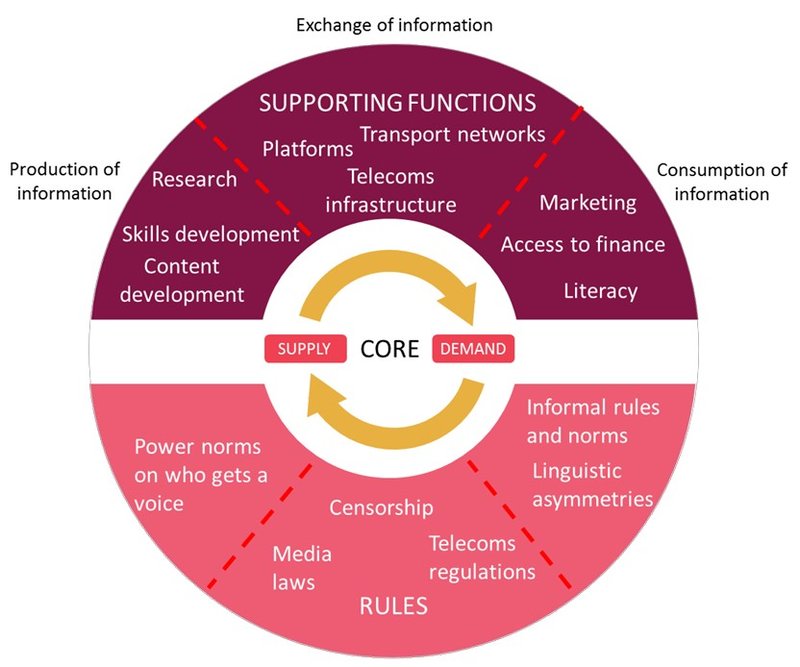
More broadly, communication can be an intervention in its own right, with market systems programmes using facilitative approaches to strengthen local media and radio so people can access better information on areas such as agriculture and health. See below for a classical doughnut model applied to the media ecosystem, taken from Making information systems work for the poor.
Leverage communications for systems change is particularly useful for project managers, communication strategists and development practitioners, offering insights into how strategic communication can facilitate systemic change, engage diverse actors and ensure sustainability and scalability of development projects.
Making information systems work for the poor considers the importance of information and the constraints to its availability and appropriateness in a development context.
Donors and the development community
Donors have embraced ideas about systems thinking, adaptive management, flexibility and facilitation. However they still need evidence to legitimise operations and engage with their own parliaments. One way to ensure strong donor communication is to have contractual mechanisms in place that promote flexibility. For example, targets and budgets that are not tied to outputs or activities, but instead focus on poverty impacts and widespread behavioural change. This allows your programme to report on narratives of systems change, which should be packaged in ways that are easily digestible and tell a compelling story.
Programme staff
Beyond regional or global learning forums, flexible and low-maintenance mechanisms for project-level learning and knowledge sharing often pay dividends. Sometimes this is as simple as a deliberate structuring of weekly team meetings on what is being learned.