- Published by
- Mercy Corps
- Project implementer
- Mercy Corps
- Donor
- USAID
- Programme
- FTF Ethiopia Resilience in Pastoral Areas North (RIPA-North)
- Results level
- Growth and access to services
- Intervention types
- Improved access to information
- Improved value chain coordination
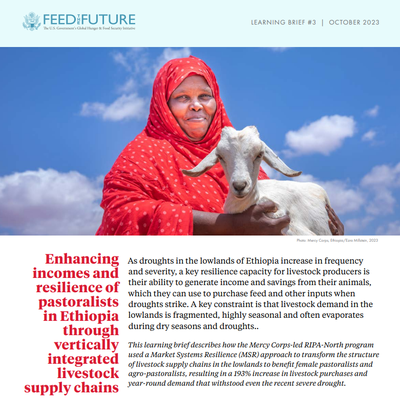
This learning brief describes describes how the Mercy Corps-led RIPA-North programme used a Market Systems Resilience (MSR) approach to improving the livelihoods and resilience of pastoralists in Ethiopia.
It focuses on restructuring livestock supply chains through market systems resilience (MSR) strategies, emphasising vertical integration and trust-based relationships.
The brief highlights the programme's success in increasing livestock sales, especially benefiting female pastoralists and agro-pastoralists.
It is useful for providing practical insights and evidence of successful interventions in the pastoralist context, offering a model that can be replicated in similar settings to enhance economic resilience.
Intervention description
Interventions included developing new business models with national buyers, such as employing regional agents, providing training on animal quality, and facilitating point-of-sale checks to minimize losses.
The programme partnered with thirteen regional traders to create Goat Aggregation Enterprises (GAEs), professionalising their operations through training, cost-share grants and disaster risk management planning.
This approach aimed to establish trust-based relationships, reduce transaction uncertainties, and improve market access for pastoralists. Evidence shows partners adopted these models and were committed to continuing these practices post-project, with 82 per cent of mini-collectors remaining active almost two years after training.