25 Jun 2024
Replicating adaptive partnerships across your organisation


Market systems development can be hampered at the project level by team culture, and at organisational level by departmental structures and a (lack of) appetite for risk.
ACDI/VOCA has been applying a market systems approach across its development projects for a decade. Despite some impressive project successes, wider adoption of the approach has been hampered by difficulty translating MSD principles into operational practice within the USAID project framework and political ecosystem.
The challenges show up most visibly at the project level, when teams need to shift their culture, approach, systems and internal relationships. However, the roots extend into the organisation itself - from departmental structures to risk appetite - and are heavily influenced by specific donors’ and personnel’s risk appetites and internal political pressures.
Launching adaptive partnership clinics
A 2021 internal assessment of operational adaptive management within ACDI/VOCA highlighted pain points and key success conditions, including operational guidance, staff capacity strengthening, and leadership commitment.
In 2023, a new working group initiated adaptive partnerships clinics. These clinics became a process for driving organisational change and learning.
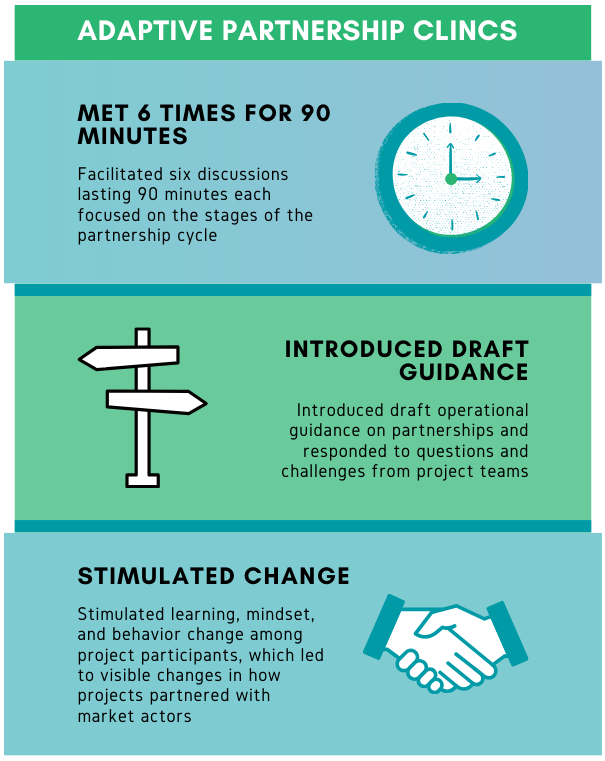
The adaptive partnership clinics brought together key organisational leads on market systems and awards management with a cohort of six new MSD projects in their first year or two of implementation. The clinics generated a few critical results:
- The quality of the draft guidance and discussions during the clinics meant ACDI/VOCA had enough information to develop and publish detailed operational guidance that was tailored to the needs and insights of practitioners. It includes guidance on how to make existing instruments more adaptive (e.g. Fixed Amount Awards).
- ACDI/VOCA was able to fast-track the design and rollout of new partnership instruments and adapted existing instruments, such as the Market Actor Umbrella Agreement and Blanket Activity Announcement, which previously had only been used in isolated cases.
While the clinics focused on partnerships, this stakeholder engagement and learning methodology has the potential to address other structural and cultural challenges at the organisational level. We have drawn out seven key principles for replication and adaptation of the model:
Seven key principles for replication and adaptation of the clinics model
- Focus on practical implementation challenges that impact more than one project 'functional' team (e.g. technical and awards or technical and MEL).
- Set boundaries on the topic and structure of each clinic session (e.g. steps in the partnership lifecycle) to tackle a different sub-topic. These parameters give focus and build momentum.
- Work with a cohort of projects that are self-motivated and willing to invest the time to learn..
• Include at least two people per project to represent different functions core to the challenge.
• Prep work is critical. Participants need to read bits of draft guidance and share questions and experiences. Without questions in advance it is difficult to be demand-driven.
• Encourage people to ask questions of peers. Over time this openness helps form a culture of honest sharing and learning. - Leverage leadership from key head office departments and among field teams with technical and operational backgrounds in each domain to perform the following:
• Draft pieces of guidance - write fresh, or adapt existing, materials to be short and accessible.
• Answer questions from projects during and between sessions. Engage in strategic thinking to agree on 'how things should be done.'
For example, cross-departmental learning and exchange includes a core group of people with different specialties, such as project management, operational and technical expertise, who have a cross-cutting perspective in their interaction with each other and project teams. This kind of innovative thinking requires trust and strong relationships across departmental and project lines, starting with solid relationships between the individuals. Not easy to replicate! - Dedicate a budget for facilitation resources to structure the process, lead the initial sessions, and draw out people to contribute freely during the sessions.
• These resources can include an external consultant, or a consistent internal facilitator. It is important not to underestimate how much dedicated bandwidth is needed to effectively see the process through from inception to outcomes. - Search for deeper changes in the organisation and be willing to propose, and champion, these ideas.
• Deeper structural or process issues may be the root cause of project pain points. Be aware of project challenges and stay open-minded about what might need to change.
• Even small instances of real structural or policy change in real-time during the clinics can be a powerful motivator. These small changes can signal to the project participants that their perspectives matter and are heard; that the organisation is willing to reflect on its own structures and practices; and that they are at the vanguard of important, bigger changes. - Assess what internal changes or processes have been made.
• Assess signs of adaptation as these indicators of change motivate and empower participants to adopt best practices in their projects and become change agents within their teams. It also helps measure the organisational impact of the clinics and share them with senior management and the broader organisation.
We think the clinic methodology is a powerful model that is not unique to adaptive partnerships. ACDI/VOCA is already exploring the potential to apply the internal clinics to challenges around adaptive and systemic MEL systems.
How organisations are applying these principles
World University Services Canada, a Canadian NGO, is currently implementing an adapted version of partnership clinics with several of its MSD projects.
Additionally, the USAID Market Systems and Partnerships Activity is currently designing an industry-level set of clinics -one for implementers and one for USAID staff - building on this experience and focusing on changing partnership practices (and organisational processes) across the industry.
We invite peer organisations interested in doing something similar to reach out to ACDI/VOCA at partnerwithus@acdivoca.org to learn more about our experience.
For more, check out the previous blog: Beyond the 'unicorn': creating adaptive partnerships across an organisation
Add your comment
Sign up or log in to comment and contribute.
Sign up