14 Jun 2024
Beyond the 'unicorn': creating adaptive partnerships across an organisation


Why is it that most USAID-funded MSD projects have inflexible and inappropriate contract structures for partnerships with market actors?
- Technical staff may not understand strategic tactics and available instruments (their strengths and limitations)
- Operations staff may not understand the market systems approach and its requirements
- There may be risk aversion and fear of not following USAID rules and regulations
- There may be a misinterpretation of USAID rules and regulations
These fundamental challenges are not new; many appeared in BEAM's 2020 MSD procurement series. Most organisations have a few 'unicorn' MSD projects that work through these problems, while the rest of them struggle to get unstuck. While significant resources are being invested in technical training and backstopping on MSD, the operational systems and mechanisms are often overlooked.
In 2023 ACDI/VOCA tested an experimental approach to help a group of six early-stage MSD projects tackle these issues. Taking the partnership cycle one stage at a time the group held clinics bringing together operations and technical staff from each project with ACDI/VOCA technical leads to challenge myths, think through key roles, and problem-solve the pressing issues.
These clinics led to two key outcomes:
- actual change in projects
- a new set of operational guidance
Actual change to projects
The clinics on adaptive partnerships contributed to visible changes at multiple levels falling into four categories:
Change 1: individual beliefs, understanding and interpretation of rules
For each stage of the partnership cycle we articulated three to five myths that block project staff from being more adaptive and flexible in their approach.
Debunking long held ideas, combined with group reflections and conversations, led to shifts in staff mindset. For example, realising they can engage partners prior to the release of an Expression of Interest (EOI) or Annual Program Statement (APS) and move ahead before the approval of a grants manual.
Change 2: individual confidence to push for internal project change
Building on those shifts in beliefs, staff were able to build their confidence promoting changes in their own projects. This was reinforced by ACDI/VOCA technical leads Award and Compliance staff who at times gave direct 'permission' for staff to break out of their old ways of doing things.
Changes include:
- making a case for change to senior management, leading to buy-in to test a new EOI and Request for Applications (RFA) process
- building confidence to push back on USAID with arguments for why new instruments and mechanisms are beneficial
Change 3: project changes to strategy and process
In the pilot group most of the participating projects followed through on their proposed changes to shift their internal processes. Frequently this included further exchanges with technical support teams and in-depth planning within their own team.
A key feature of the group was that each project had at least one technical staff member with MSD experience, and one operations staff member with grant and sub-award experience who joined the clinic sessions together. This led to some meaningful changes in how projects operated, including:
- increased information flow and trust between technical and operations teams
- rethinking of the co-creation process, using systems change and results chains to target which partners and what type of changes
- modifications to APSs and grants manuals
- proactive engagement with partners before a funding grant window
Change 4: organisational policy changes
During the same pilot period, ACDI/VOCA developed and formalised a new instrument - the Market Actor Umbrella Agreement - which responded to key requests from several of the participating projects. This tool had previously been used in a 'unicorn' project but hadn’t been institutionalised or made widely available.
A new set of operational guidance
Our newly published operational guidance is a product of in-depth conversations with multiple MSD project teams. It reflects their input and experience throughout four phases in the partnership lifecycle:
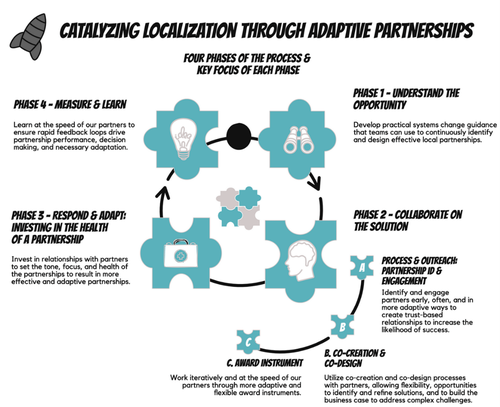
For each stage the guidance includes: basic framing of the issue; key myth-busters; team members’ roles; and key tools, resources and examples.
ACDI/VOCA’s experience was that working through the guidance one stage at a time - with ample time for project teams to react, ask questions, and share examples - was key to generating buy-in, shifting beliefs, and building their confidence to initiate internal changes within projects.
Some of the most powerful, prevalent myths dispelled during the clinics included:
- “Our success is primarily measured in how efficiently we spend grants according to the plans laid out in our budget and annual plan.”
- “Because of ‘procurement sensitivities’ we cannot discuss potential or planned programming with the private sector, which limits co-creation opportunities.”
- “Solicitations (e.g. APSs, Request for Applications - RFAs etc.) can only happen after inception analysis is complete and the grants manual is approved.”
- “Co-creation always results in a grant or award to a partner.”
- “You cannot meet with potential partners until the APS or RFA is published.”
- “You cannot start actively partnering or giving grants until the grants manual is approved by USAID.”
Although the guidance is targeted towards USAID-funded MSD projects, you can find insights from a wider range of donors in Fit for business: modifying internal procurement processes to suite adaptive MSD programmes, from BEAM’s MSD procurement series.
Stay tuned for some exciting new content in adaptive partnerships, and read our second blog on tips and tricks for replicating adaptive partnership clinics to spur organisation-wide change.
- Download ACDI/VOCA’s operational guidance: Catalyzing localization through adaptive partnerships: operational guidance to working with and through local partners across the partnership cycle
- Read our second blog: Replicating adaptive partnerships across your organisation
Add your comment
Sign up or log in to comment and contribute.
Sign up