6 Sep 2025
Measuring inclusion: uncovering the invisible women in Nigeria’s poultry sector


Measuring inclusion in MSD programmes is harder than it looks; data can easily misrepresent who truly benefits.
In rural northern Nigeria, it is mainly women who own and care for chickens, feeding them scraps from the kitchen and relying on them to feed their families and earn extra income. Yet, monitoring data from Propcom+ - a UK-funded climate-smart agriculture programme - revealed that only 22 per cent of farmers receiving chicken vaccinations were female.
At first glance this might not seem alarming considering the programme operates in northern Nigeria - a region known for stark gender inequalities. However, knowing that the poultry sector is overwhelmingly female-dominated in Nigeria the data did not seem right. So, how were we missing so many women in our data?
The hidden flaw in data collection
The reason is simple. Vaccinators, such as Community Animal Health Workers, are largely male and cultural and social norms in northern Nigeria restrict male-female contact outside the family. So, even when a woman is the primary poultry farmer, her husband, or another male relative, would take the chickens to be vaccinated. At the vaccination site, Animal Health Workers would wrongly record the beneficiary as male. Our data, as a result, failed to account for the true role of women in the poultry sector.
This case highlights the challenge of measuring inclusive impact in MSD programmes such as Propcom+, where monitoring data is gathered through implementing partners and service providers. In effect, Animal Health Workers take on the role of researchers, collecting crucial monitoring data that can be influenced by complex social dynamics and biases, especially about gender.
Significant distortions in beneficiary reporting undermines the programme's ability to accurately measure impact and make programme design decisions.
What’s the solution?
Uncovering inaccuracies, as seen in the poultry vaccination data, allowed us to identify where the process was failing. As a result, we updated the data collection tool by adding a question on livestock ownership.
With Propcom+ support, partners have held refresher training for Community Animal Health Workers, highlighting the importance of accurately determining ownership.
Adjusting data collection paid off; we saw increases in the percentage of women among new beneficiaries (see Figure 1). In total, in Year 2, the programme’s animal health interventions reached 45 per cent of women farmers, with the most recent quarter recording 58 per cent.
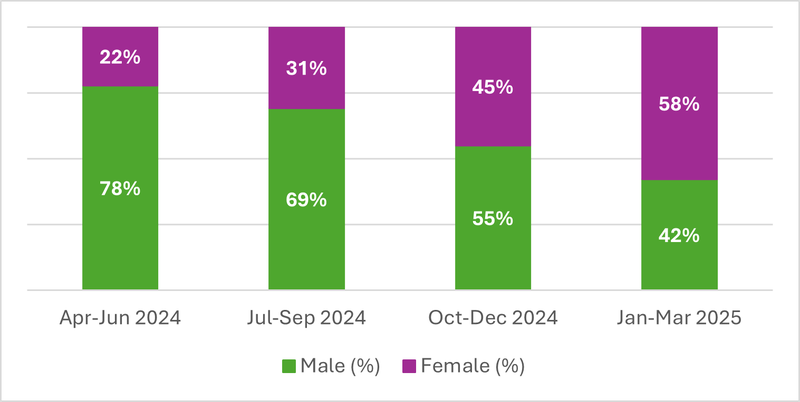
Source: Propcom+ monitoring data, March 2025
Beyond simply adjusting data collection tools, there is a need to reconsider how we collect data on Gender Equality and Social Inclusion (GESI). Relying solely on quantitative data does not capture the full picture, especially when it comes to complex, socially embedded issues such as ownership and care.
Complementing quantitative data with qualitative insights will provide a more nuanced understanding of who truly benefits from Propcom+ interventions. This cannot be left solely to partners; it is a core programme responsibility to be captured through baselines, endlines, impact evaluations and targeted GESI studies.
Looking ahead
Supporting our partners to collect accurate data will be critical. This involves not only training but also fostering an understanding of the importance of capturing the lived realities of excluded groups.
By doing so, we gain a more accurate measure of a programme’s impact on women, while partners gain valuable insights into reaching underserved consumer groups, ultimately boosting their revenue.
Such data can also serve as an entry point to support partners in shifting attitudes and challenging their biases.
Accurate, inclusive data is more than a monitoring tool - it’s a catalyst for business growth, resilience and more impactful MSD programmes. By asking the right questions, training partners to recognise bias, and combining quantitative and qualitative insights, programmes such as Propcom+ can uncover the true beneficiaries of market interventions, recognise inequalities and ensure women and their roles are visible.
When we count accurately, we design smarter solutions - and create stronger, fairer markets for all.
Add your comment
Sign up or log in to comment and contribute.
Sign up