21 Nov 2024
Listening to the data: advancing GEDSI in MSD through nimble and well-integrated M&E systems


Having an understanding of gender and social inclusion helps make development programmes, especially MSD, more inclusive and effective.
I spoke with Gianluca Nardi, an experienced GEDSI advisor who recently joined To’os ba Moris Di’ak (TOMAK: Farming for Prosperity) in Timor-Leste1. The programme aims to support rural Timorese households with improved food security, nutrition, and productive, profitable, and resilient agriculture-based livelihoods. Before this, he spent six years advising Strongim Bisnis in the Solomon Islands2.
We discussed his experiences in the GEDSI field, including being a man in this space. Our conversation highlighted four key insights for development practitioners aiming for more equitable impact.
1. Ensure your M&E can deliver disaggregated insights
A robust yet flexible M&E system is key to achieving more equitable impact - Gianluca believes it needs to capture and produce disaggregated data on key indicators related to participation. TOMAK’s M&E system disaggregates data by gender, age and disability status, allowing for intersectional analysis:
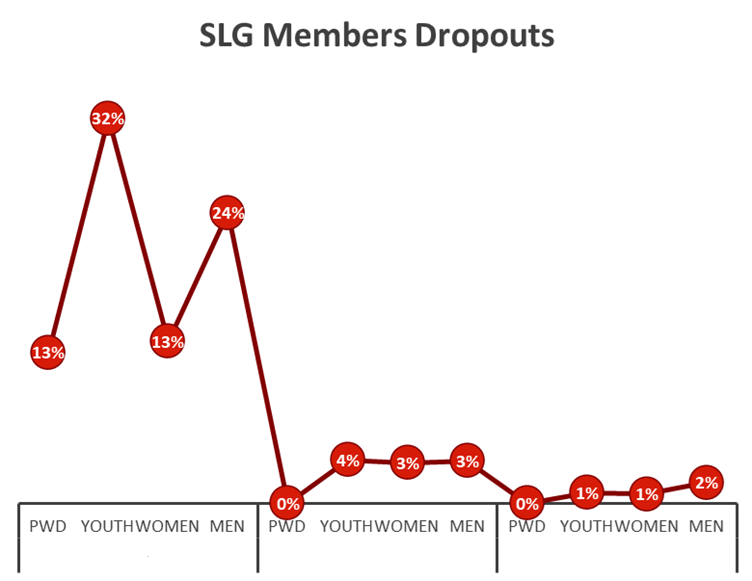
Image 1: Screenshot from TOMAK’s M&E system showing disaggregated savings and loans group (SLG) dropout rates by geographic location
“We have a picture of what is happening at all times because we need to understand the impact of our work on different groups, including from an intersectional perspective.”
For TOMAK, having an M&E system that can provide sex-disaggregated insights is essential.
Their data revealed a surprising trend: the declining involvement of men in small-scale agriculture because other economic activities (including seasonal workers programmes) were perceived as better income-generating options. This data reshaped an initial assumption held by key stakeholders that increasing yields would require more men in agriculture.
The underlying constraint for productivity was not the absence of men but women’s time constraints and reduced mobility. This impacted their ability to access information, inputs and extension services.
Access issues for women were further exacerbated by extension services being primarily delivered by men - who tend to interact only with other men. So addressing the underlying causes of women’s low productivity, while improving economic opportunities in agriculture, was the way forward.
Gianluca also recommends regularly capturing qualitative data to complement quantitative data. His programme adapts indices, such as the women’s empowerment agriculture index (WEAI), to better understand changes on the ground.
“The key is having a flexible M&E system that at any moment can be deployed to conduct rapid surveys to better understand the reasons for changes in participation levels in project activities. It's important to be able to customise the surveys to understand what's going on with a certain level of depth.”
2. Look closely at the data on care work
Strongim Bisnis’ preliminary gender analysis revealed that childcare was one of the most time-consuming activities for women in both rural and urban areas.
Delving deeper into the data they learned that while several government programmes offered childcare in the Solomon Islands, there was no provision for the under three's. So, despite childcare being a key constraint, Gianluca and his team saw it also as a potential business opportunity.
Employee absenteeism due to care responsibilities posed a major challenge to labour-intensive businesses such as tuna canning in the Solomon Islands, prompting the private sector to seek assistance from Strongim Bisnis.
“This was actually driven by the private sector, which helped make the business case for intervening in childcare.”
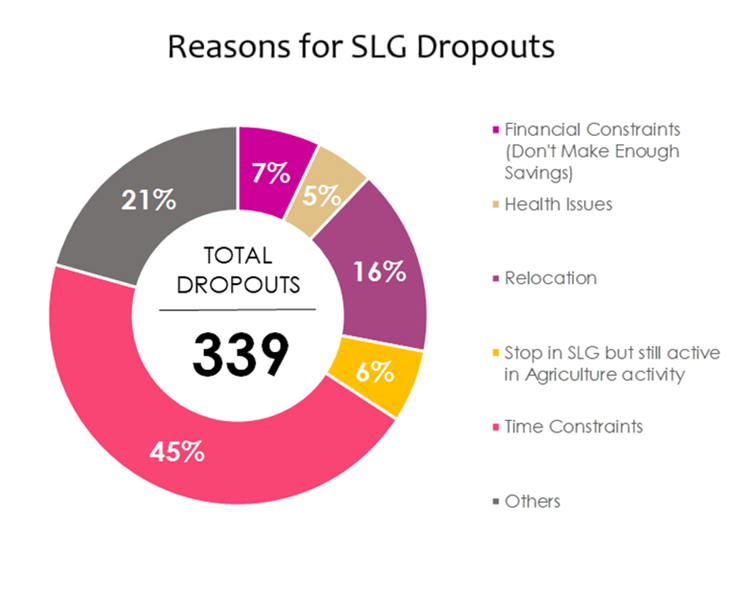
Image 2: graph summarising qualitative data from TOMAK on the different reasons people dropped out of savings and loans groups (SLG).
In TOMAK's case, data from their robust M&E system provided nuanced insights into why women were dropping out of a core programme activity: savings and loans clubs.
M&E qualitative data revealed that care-related time constraints were the main cause (Image 2). By identifying time poverty as a key constraint for women, TOMAK adapted its intervention to provide incentives for couples, rather than individuals, to participate in the programme’s initiatives and embedded 'Household decision-making' training modules in most programme activities.
These adjustments are expected to result in more equitable decision-making and task-sharing at the household level, while also preventing conflicts.
3. Create a culture of curiosity through strong collaboration between implementation and M&E teams
Gianluca attributes the culture of curiosity to the strong relationship between the implementation and M&E teams. He also emphasises the importance of leadership (and donors) being open to risk-free discussions about what works well and what needs improvement.
“I think there is a very good interaction with the M&E team. Sometimes they would present data from their periodic surveys, and this data would raise questions and prompt further investigation. Together with the M&E team we would design surveys that might clarify some of these questions.”
4. Engage and incentivise men to advocate for GEDSI
Men in the project and community are often underutilised in promoting GEDSI. Gianluca advocates for engaging men at all levels, having found powerful advocates in the public sector, private sector and the community.
“I think it's a very good tool to involve men. It's not easy. Sometimes there is not a strong personal interest coming from individual life experience, but in the case of the private and public sector, a clear business case helps move the agenda forward.”
Despite it being relatively uncommon, being a man working on GEDSI hasn't been an obstacle for Gianluca. He has had no issues discussing GEDSI with organisations or colleagues, particularly after making initial efforts to earn their trust. Often, he finds that being a man gives him an advantage in bringing other men on board.
“I just spoke about the business case and what I thought needs to be done. I find that men listen with a certain interest, especially when I talked with the local private sector in Solomon Islands or with youth groups. I had a lot of success involving other men, both from the private sector and the youth space.”
Gianluca didn’t start as a GEDSI advisor. He has a background in economics and MSD. He became interested in the topic after developing a ‘women in value chain strategy’ for Care International UK several years ago. From there, his passion for the topic grew as he saw that understanding gender and social inclusion dynamics made development programmes, especially MSD, not only more inclusive but more effective.
He views gender as one lens for gaining deeper, multi-faceted insights into the dynamics within economic systems.
1. The Australian Department of Foreign Affairs and Trade (DFAT)'s ten-year (2016 – 2026) run by Adam Smith Int. Australia
2. The Australian Government's economic development initiative in the Solomon Islands, run by ASI Australia, to increase economic opportunities and participation for people and businesses. The initiative targets sectors that have a high potential for growth (coconut, cocoa, tourism, horticulture, timber and waste management) and that can consequently create new employment and income generation opportunities. Strongim facilitates strategic partners (including businesses, government, civil society, and associations) in those sectors to address the root constraints to growth and inclusion (Women, Youth and People living with disabilities) through innovative solutions.
Add your comment
Sign up or log in to comment and contribute.
Sign up