
In this blog we share some valuable lessons from SHARPE Ethiopia on using and negotiating grants to spark innovation and market system change in the private sector.
At the end of last year I had the privilege of travelling to Ethiopia to produce a study for the Strengthening Host and Refugees Populations in Ethiopia (SHARPE) programme. SHARPE is a fascinating and highly innovative programme working at the intersection of market systems development and humanitarian relief.
I was asked to look at how SHARPE had used grants to catalyse change and innovation in private sector actors. SHARPE is a great programme to explore this topic given the huge variety of enterprises they have engaged. Broadly, these fall into three categories:
- Large, national companies, often headquartered in Addis Ababa
- Small and medium companies, typically owned by entrepreneurs in the host community
- Micro-enterprises, typically refugee-owned but also host-owned, and often informal
Let’s explore some of the lessons and insights from the study.
What were the grants used for?
In general, the purpose of the grants was to catalyse the integration of host and refugee communities into high-potential supply chains. For larger companies, this meant using grants to incentivise firms to expand into host and refugee markets and ‘test the water.’ The idea was to buy-down risk for first-mover companies.
For refugee-owned micro-enterprises, grants were used to support enterprises to reach a size and sophistication where they could participate effectively in wider supply chains. Given their low levels of income and difficulty accessing finance, grants were used to provide a substantial part of the necessary financing. Host-owned enterprises were also supported to grow, and to more effectively link large companies in the capital or regional centres with refugees.
Interestingly, SHARPE grants have included cost-shares for assets such as buildings or equipment. For example, SHARPE cost-shared the construction of pilot satellite bank branches in refugee camps by Shabelle Bank. This contrasts with the guidance provided by some other market systems programmes such as KATALYST in Bangladesh or PRISMA in Indonesia (the PRISMA Deal Making Guidelines states that funding equipment or infrastructure should be avoided “as this can give unfair advantages to a firm and reduce potential for replication”).
SHARPE staff told us that, given the very challenging context, it was important to be able to cost-share infrastructure and hardware if that is what is required to catalyse the desired innovation. We also found emerging evidence that where companies like Shabelle Bank had invested in infrastructure in refugee markets, they were more likely to sustain their commitment to these markets post-grant.
How does the size of the grant and the cost-share vary by type of enterprise?
Reflecting the diversity of the grantees, the grants provided by SHARPE varied significantly in value, from under £100 to over £200,000. There was also a large variation in the cost-share provided by SHARPE, from 35 per cent to 88 per cent (based on the commitments in the grant agreements).
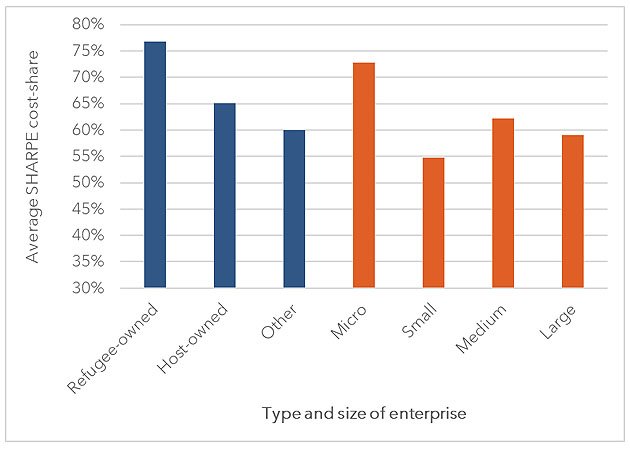
In the full study we made various predictions about how the cost-share might vary depending on the type of enterprise. In general, we found that the cost-shares provided by SHARPE matched these predictions. For example, the average cost-share was highest for refugee-owned businesses, followed by host-owned businesses, then ‘other’ businesses. Given that refugee-owned enterprises, followed by host-owned enterprises, are least likely to be able to access internal or external finance, this is consistent with the conceptual model. The cost-share also falls as the size of the enterprise increases, although with an anomaly for ‘small’ enterprises – also consistent with the model.
For the study we were also hoping to benchmark the cost-shares provided by SHARPE with other programmes operating in similar contexts. Unfortunately, we could not find much publicly available cost-share data. Anecdotal evidence suggests that the SHARPE cost-shares are generally higher than other programmes, but not other programmes operating in Ethiopia. This again is consistent with the external literature given that the areas SHARPE operates in can be characterised both as thin markets and donor-heavy contexts.
Is there a danger that high cost-shares lead to unsustainable outcomes?
One of the reasons people give for not providing high cost-shares is that they increase the risk that the company is simply ‘in it for the money’ and will not sustain the innovation beyond the end of the grant.
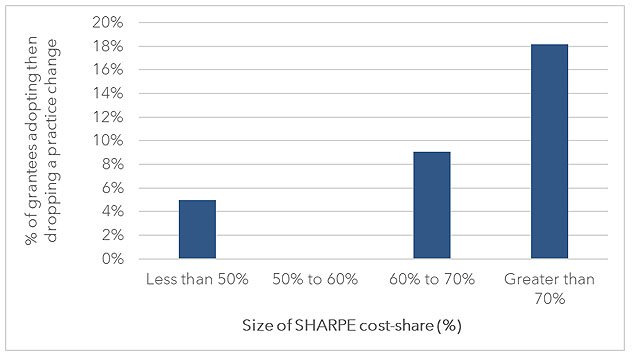
Combining data from the SHARPE grant tracker with data from the monitoring system, we analysed how the rate of adopting and sustaining practice changes varied across the portfolio. The data does suggest that grantees receiving a high cost-share are more likely to adopt then drop a practice change: where the cost-share was less than 50 per cent, only 5 per cent of grantees adopted then dropped a practice change, versus 18 per cent of grantees where the cost-share was greater than 70 per cent. If the analysis is repeated for medium and large enterprises only, two-thirds of the grantees receiving a cost-share of 70 per cent or more adopted then dropped the practice change.
This early evidence suggests that, when providing grants to larger firms, programmes should indeed be cautious about providing high cost-shares.
The art of the deal…
A fully formulaic approach to cost-sharing is probably not feasible given the multitude of different businesses and innovations supported by MSD programmes such as SHARPE, and the variety of contexts. Finalising a grant agreement is also a negotiation, with the outcome partly dependent on the negotiating power and skills of each side.
To negotiate the best deal, it may be useful to provide staff with cost-sharing benchmarks for different types of enterprise – both internal benchmarks from previous grants and external benchmarks from comparable projects in the country and elsewhere – and written guidance on the factors determining when and why the cost-share might deviate from these benchmarks.
To aid this effort, we could perhaps all do better at publishing cost-share data from our programmes – through platforms such as the BEAM Exchange – so we all have a richer set of benchmarks to draw on.
Read the rest of our lessons and recommendations: Using grants to catalyse market systems change in the context of host and refugee communities
2 comments
Thank you for sharing these insightful field observations, Gareth!
I do have a mixed reflections on your report.
I agree that it is difficult to find the proper lead firm (large national company) for program target area. Getting the lead firm may be simple, but ensuring its survival is more difficult. On the other hand, holding various co-creation meetings at early stages will enhance honest, open communication and foster trust, allow us to provide proper (if not perfect) decisions. This will further contribute to the partnership's success. Additionally, in order to determine whether the lead firms (potential market participants) have presented workable ideas or a viable business model and whether they are sincere about our shared objective and the suggested business model, we must, to the extent possible, take the aspect of competition into account when inviting and selecting the lead firms.
additionally, the program and compliance team must consider all the steps and use appropriate terminology while choosing the right firm.
For instance, you have repeatedly used the term cost share but better to refer to the subaward grant as a 'partner contribution' rather than 'cost share' because it is a partnership commitment made under a subaward agreement to accomplish a shared objectives. The way we value the cost share and contribution differs, thus we must completely comprehend and distinguish between the two. Issues with compliance must be guaranteed. This is a subaward fund contribution by a competitive mechanism that encourages market participants to take up novel, long-lasting behaviors that improve market systems.
Furthermore, in order to lower the risk of uncertainty, it is usually a good idea to pilot interventions first at a modest scale and plan later on for scale through a second round subaward partnership with the lead firms.
Hi Faji,
Thanks very much for your comments.
Yes, I 100% agree with your comment about the importance of early engagement with partners, including co-creation sessions, discussing and sense-checking the business model, and getting a feel for the partners' level of commitment and buy-in. SHARPE did a great job of this, and we touch on some of this in the full paper (available on BEAM).
I also like your suggestion of using the term 'partner contribution' rather than 'cost-share', given the importance of using grants in the context of a wider partnership.
Thanks again,
Gareth
Add your comment
Sign up or log in to comment and contribute.
Sign up