While every market system is different and every context is unique, in general, market systems programmes tend to evolve through three main phases: piloting interventions, sometimes referred to as probing or testing; building momentum with partners; and scaling up towards systems-wide interventions.
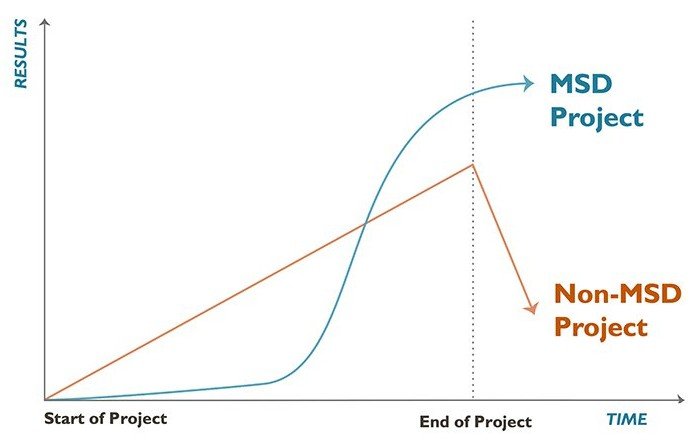
This means there tends to be a ramping up of activity towards the latter half of a programme, or rather a shift from analysing markets and building partnerships to scaling out interventions. See image below, borrowed from Is the MSD hockey stick fact or fable? for an example of what this looks like in theory.
Piloting interventions
Programmes adopting a market systems approach will use pilots, sometimes referred to as ‘probes’, as a method for initially testing and refining an intervention strategy. Piloting in market systems programmes involves working with an initial partner to see if a new innovation works, before committing to scaling up with other partners. This is always preferable to building a full intervention plan based on an untested understanding of how a particular market system or partner operates.
Once a partner is identified, this type of approach differs from traditional partnerships in that relationships are contingent on signs of partner improvement and ownership. Some things to keep in mind:
- The pilot should be long enough that it is an adequate test for the innovation. If it’s a change in a customer service strategy, you don’t just want to see boosts in sales, but also increases in repeat customers.
- The pilots should be carried out at a strategic time (such as a farming season). Think about the partner’s timeline and how much time you need to negotiate.
Pilots do not have to be with businesses. There are numerous examples of this type of approach being applied to areas of market governance and the provision of public goods.
In Working with the private sector for systemic change, Dan Langfitt outlines how the Inova programme in Mozambique went about establishing a partnership facility to work with local firms.
Building momentum
Understanding trends and developments in a market system can help you predict its potential for change. As such, ‘momentum’ is a term used often by market systems practitioners because it signifies positive movement in behavioural patterns and norms with regard to partners, and also regarding the market as a whole. To know if you are building momentum with a partner, the following questions are useful:
- Is the partner doing the action themselves?
- Do they have plans to continue with it in the next quarter?
- Are they adopting this innovation in other aspects of their work?
- Are competitors starting to feel pressure? Are they changing aspects of their behaviour to match those of your partner?
The partnership health assessment tool provides a framework and practical guidance for examining the resources, behaviours and relationship dynamics that shape the success of a partnership. The tool helps practitioners understand where to focus in order to strengthen their partnerships and strategies in anticipation of making pivots, if necessary.
At the market systems level, identifying whether or not momentum is occurring is more challenging. A good place to start is to identify whether there have been any reactions from other market players and to build on that momentum. For instance, if a commercial model was piloted, assess whether competitor firms have reacted to it by making similar changes in their operations. This is often referred to by market systems practitioners as ‘crowding-in’ , implying that you are building momentum in your market system.
Momentum is hard to quantify. Experienced market systems practitioners often know when it is happening based on discernible changes in attitudes and ways of speaking among lead firms, as opposed to quantitative indicators. Looking for it requires having systems in place that allow for operational flexibility that allows you to monitor useful qualitative indices as well as good networks across the market system.
Moving to scale
The purpose of a pilot intervention is to prove if an innovation can work in your market system. Once accomplished it is time to move to ‘scale’. As with many complex terms in development, such as ‘poverty’, scale is defined principally by context. For our purposes, scale can be defined as having been reached when a large number (again, large depends on context) of non-target market actors have taken on a new market innovation and that this is in turn having a positive impact on the lives of an even larger number of people. The Springfield Centre’s Adopt-Adapt-Expand-Respond (AAER) framework provides useful guidance on identifying signs of scale.
AAER revisited reviews the use of this tool in market systems programming, arguing that with some relatively minor reframing of the concepts underlying AAER, the framework can be used effectively as an analytical tool that goes beyond storytelling to help us understand why systemic change happens.
Reaching scale should be intentional, meaning that you cannot simply rely on your pilot partner to demonstrate a new innovation and expect their peers to adopt or adapt the idea as a result. Scaling up will often involve working with early adopters as well as a group of ‘second movers’. Often your support to them will need to be just as - if not more - intensive than your support to your initial partner.
From pilot to scale explores strategies to reach scale within MSD programmes.
Impact at scale looks at the challenge of moving beyond an isolated pilot to achieve widespread impact. It suggests paying serious attention to the commercial aspects of business innovation and the value of more rigorous commercial analysis and strategic thinking before investing in pilot interventions.