Setting out a future picture where the market system works more efficiently requires thinking about which players are best suited to perform which functions.
Who Does? Who Pays? is a useful framework to help you decide whether your activities will lead to sustainable behaviour change.
More on this tool and how to apply it can be found in The Making Markets Work for the Poor Guide: Chapter 3 vision.
How the tool works
The framework looks at the existing and potential future incentives and the capabilities of market actors. Start using the tool by answering two questions.
- Who ‘does’ what currently, and who will do what in the future? This question centres on identifying the key actors responsible for performing essential functions within the market system. These functions might include:
- Service delivery - providing training, technical assistance, financial services or other support to market actors.
- Regulation and enforcement - setting and enforcing standards, rules and regulations within the market.
- Information provision - gathering, analysing and disseminating market information to support decision-making.
- Advocacy and representation - representing the interests of market actors and advocating for policy changes.
- Coordination - facilitating communication and collaboration amongst different actors in the market system.
- Who ‘pays’ for what currently, and who will pay for what in the future? This question focuses on identifying the sources of funding and resources needed to sustain the performance of essential functions over time. This can include:
- Private sector investment - investments by businesses and entrepreneurs within the market system.
- Government funding - funding from government agencies, including taxes, fees and subsidies.
- User fees - payments made by beneficiaries of services or products.
- Donor funding - external funding from international development agencies, foundations or other philanthropic organisations.
- Hybrid funding models - a combination of public and private funding sources.
Once you have mapped ‘Who does? Who pays?’, set out a picture of the future. Think about your future vision of a functional market system: who will do what function, and who will pay for it? Consider what incentives your target partners have (and will continue to have) to change their behaviour towards this desired future state. See below for an example taken from the Making Markets Works for the Poor Guide.
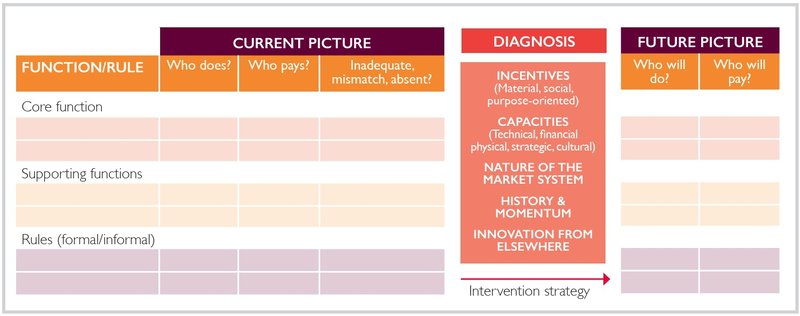
Who does? Who pays? provides a quick template for the tool.
The benefits of applying a ‘Who does? Who pays?’ lens
The 'Who Does? Who Pays?' framework is invaluable in the visioning stage of MSD, as it encourages a forward-thinking and realistic perspective on sustainability. By considering these questions early in the process, practitioners can:
- Identify potential gaps and weaknesses:
- Are there essential functions that are not currently being performed effectively or are not being performed at all?
- Are the current providers of these functions reliant on donor funding, which may be unsustainable in the long term?
- Are there incentives for private sector actors to step in and assume responsibility for these functions? - Explore sustainable funding models:
- Can user fees be implemented to cover the costs of service delivery?
- Can government agencies be incentivised to allocate more resources to support these functions?
- Are there opportunities to leverage private sector investment through innovative financing mechanisms? - Define roles and responsibilities:
- Who are the most appropriate actors to perform key functions in the long term?
- What are the incentives and disincentives for different actors to assume these roles?
- What are the capacity-building needs of these actors? - Align incentives:
- Are there existing market failures or perverse incentives that are undermining the sustainability of these functions?
- How can interventions be designed to align the incentives of different actors and create a more sustainable market system?
A market system strategy for COVID-19 vaccination in country x provides a comprehensive case on how to apply the ‘Who does? Who pays?’ framework to develop a vision for a market system, in this case vaccination roll-out in an imaginary country.