A theory of change (ToC) is a crucial tool for market systems development (MSD) programmes. It outlines how a programme expects to achieve its desired impact by mapping the causal pathways between activities, outputs, outcomes and ultimate goals.
A well-articulated ToC can help your programme to:
- Clearly articulate assumptions and hypotheses about how the market system works.
- Identify the most effective and efficient interventions.
- Monitor progress and adapt strategies based on evidence.
- Communicate your programme's logic to stakeholders.
- Promote accountability.
Complexity informed theory of change explains how a complexity-aware theory of change approach can help managers develop appropriate strategies for interventions and focus their attention.
Developing a theory of change
A theory of change lays out the series of cause-and-effect changes that follow intervention activity. This represents your programme’s vision of how market systems will function in the future, the outcomes this will result in and the impacts it will have on your target population. Theories of change are often represented in diagrams, illustrating the types of interventions that bring about the outcomes depicted in the pathway of a change map.
See below for an image adapted from Using systemic M&E tools which outlines a high-level causal logic often included in theories of change for market systems
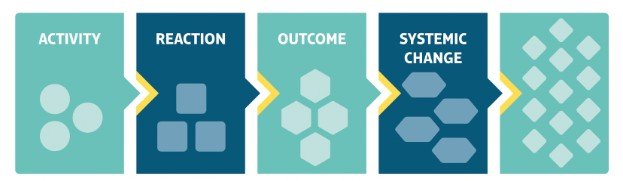
In your theory, each outcome should be tied to an intervention, revealing the often-complex web of activity that is required to bring about change. A theory of change should capture the team's current thinking and assumptions on how change will happen so that they can be explored and rebutted if, and where, necessary. It is different to a logical framework as it requires you to articulate underlying assumptions and is meant to change your way of thinking about initiatives from 'what you are doing' to 'what you want to achieve'.
Core principles of a good theory of change for MSD
- Systemic perspective: your ToC should focus on how interventions will lead to changes in the overall market system, not just on the direct beneficiaries of the programme.
- Causal pathways: the ToC should clearly articulate the causal relationships between activities, outputs, outcomes and impact. Each step in the pathway should be logical and supported by evidence or strong assumptions.
- Assumptions: the ToC should explicitly state the assumptions that underpin causal relationships. These assumptions should be tested throughout the programme.
- Measurable indicators: the ToC should identify measurable indicators for each step in the causal pathway. This allows the programme to track progress and make necessary adjustments.
- Adaptability: the ToC should be flexible enough to allow for adaptation and learning. The programme should be prepared to revise the ToC as new information becomes available.
Four ways to increase experimentation in your theory of change outlines four management techniques to ensure the ToC remains an adaptable document and that strategies remain dynamic.
How to develop a ToC
(further guidance provided in Developing a theory of change)
Start by identifying your outcomes. These are the medium-term results that are expected to occur as a result of the programme. They should be specific, measurable, achievable, relevant and time-bound (SMART). Next, determine outputs. These are the direct products and services that the programme will deliver. Then, define your activities. These are the specific actions that the programme will undertake to produce the outputs.
Once this is done, start to map your causal pathways. This involves connecting the activities, outputs, outcomes and impact in a logical sequence. For each pathway, ask:
- How will this activity lead to this output?
- How will this output lead to this outcome?
- How will this outcome lead to the ultimate impact?
Lastly, make sure to identify key assumptions. What assumptions are you making about how the market system works and how your interventions will lead to change? These assumptions should be explicitly stated and tested throughout the programme.
The building blocks of a programme theory outlines a tool meant to strip back the process of changing a market actor’s behaviour to its essential elements, or ‘building blocks’, to better understand what is actually happening when interventions work. The four building blocks relate to a changed behaviour, a rationale for it, blockers stopping the change as well as change resources (i.e. what a programme has at its disposal to promote a desired change).