Programmes that use the market systems development (MSD) approach aim to foster enduring systemic change within markets, contributing towards lasting and inclusive economic opportunities.
A well-defined strategic framework is crucial for guiding MSD programmes, ensuring that they are focused, effective and adaptable. Such a framework provides clarity and consistency, facilitates learning and adaptation, and improves communication with stakeholders. In the early stages of programme design, it also ensures that funding approval can be sought and decisions made.
While every context is different, developing a strategic framework always involves some common elements:
Define the overarching purpose
Begin by clearly articulating your programme's overall purpose: what broad development challenge are you trying to address? This should align with the needs and priorities of your target population.
Example questions include:
- What specific problem is the programme aiming to solve
(e.g. poverty reduction, improved livelihoods, increased food security, enhanced resilience to climate change or some combination)? - What is the target population
(e.g. smallholder farmers, micro-entrepreneurs, women, youth)? - What are the long-term development goals that the programme is contributing towards
(e.g. Sustainable Development Goals, national development plans)? - How does the programme align with the needs and priorities of stakeholders in the broader system,
and how has this been determined?
For more information on strategic frameworks, explore Systemcraft, which has guidance on developing strategies when operating within complex systems.
Define geographic and thematic scope
Next, define the programme's geographic and thematic scope. Be realistic about what can be achieved with available resources and your timeframe. Consider existing market assessments and analyses to identify key opportunities and constraints.
The scope should be neither too narrow, limiting the programme's potential impact, nor too broad, leading to a lack of focus. It is important to consider:
- Geographic boundaries:
Where will the programme operate (e.g. specific regions, districts, communities)? Justify this selection based on factors such as need, strategic importance and potential for impact. - Thematic focus:
What sectors or value chains will the programme target? (e.g. agriculture, finance, renewable energy, tourism)? Prioritise based on factors such as economic potential, impact on target beneficiaries and alignment with programme purpose. - Constraints and considerations:
Analyse and adapt the scope according to issues and needs in the region. What existing programmes or interventions are already in place, and how will the programme be complimentary? What resources are available to the programme, and how will this impact scope?
Identify opportunities to benefit your target group
Next you will need to identify, initially at a very high level, how the programme will foster positive change within a market system. This should take into account the type of interventions planned, whether that involves stimulating innovation, improving access to information, building the capacity of market actors, or advocating for policy reform. The key thing to remember is that interventions should be designed to be market-based and sustainable.
This good practice note on developing sector strategies provides useful advice.
Identify core activities and their logic
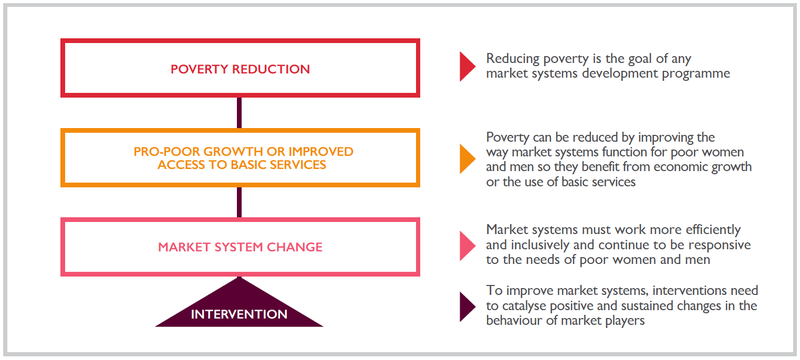
Next, translate these steps into a set of core activities tol be undertaken. Each activity should have a clear logic – a well-defined pathway from the activity itself to the desired outcome. This logic should be based on a sound understanding of the market system and the likely responses of different actors. Outline how the activities should support and strengthen each other, or how resources should be dedicated to each set of activities. See below for a high-level strategic framework from Chapter 1 of the Operational Guide for the M4P Approach.
Map your assumptions
Lastly, any intervention strategy should make clear your assumptions about how change in the market system will happen. It should explain how each step in your Theory of Change is expected to lead to the next. Assumptions also describe external factors that may enable or constrain the course of events. Making them explicit in this way is important, since many may turn out to be false.