12 Nov 2024
Is the 'MSD hockey stick' a fable or a fact? Early lessons from the USAID ex-post series

Our ex-post studies are confirming that MSD programming is creating sustainable and scalable change following closure that is continuing to benefit target populations.
Four years ago we set out to investigate what evidence exists for the famed MSD ‘hockey stick’ effect. The idea is that MSD programming - by focusing on facilitation to achieve deeper, systemic changes - delivers more sustainable and scalable results than programmes using more direct programming approaches.
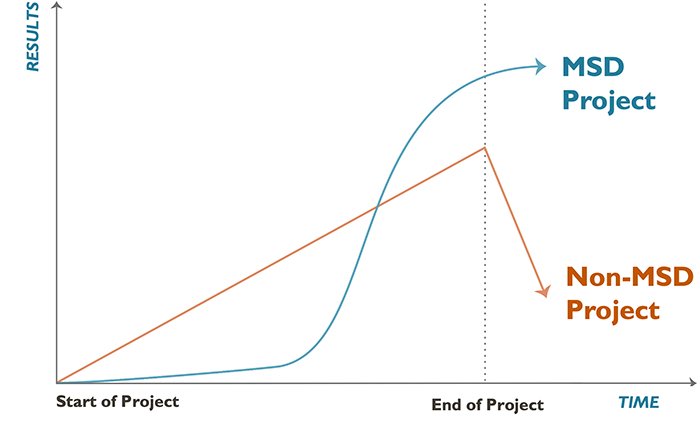
But does this play out in practice, or is it more theory than reality?
As past BEAM MSD evidence reviews have noted, like this one from 2019, actual evidence for the impact of MSD post-closure is thin. Without that evidence base, funders may understandably question the value of ongoing support over approaches that work directly with target populations. The latest 2024 review echoes this call.
USAID’s DAI-led Feed the Future Market Systems and Partnerships (MSP) programme is joining others in setting out to change that by conducting a series of five ex-post studies of USAID-funded programmes applying aspects of an MSD approach that had been closed for at least three years at the time of the study.
MarketShare Associates has now completed two studies in Senegal and Ghana, with three more in the design phase in Bangladesh, the DRC and Mozambique.
What are some of our early lessons?
In both countries the changes facilitated by these activities have proved largely durable more than three years post-closure.
The case of Senegal is fascinating. The integrated financing model (IFM) that enabled rice processors and farmers to gain better access to credit has spread from two to seven value chains since the programme closed. It led to 685 per cent more asset-backed credit provision in 2022 than in 2019. The model has been formally endorsed and supported by the Government of Senegal and has been leveraged by other funders to launch a complementary warehouse receipt system for farmers to borrow against their harvest.
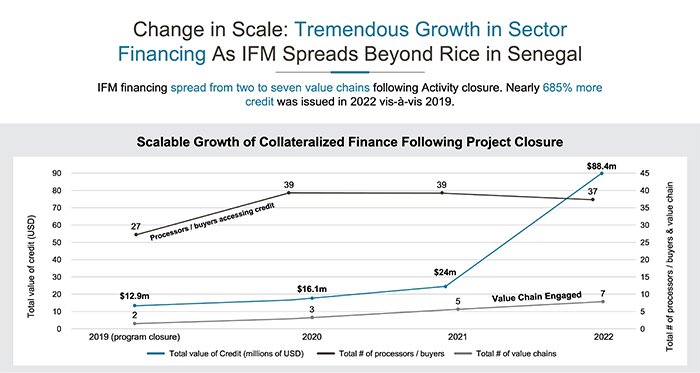
The impacts of this systemic change have been transformative: Senegal is one of only a few countries in West Africa where domestic rice processing capacity has grown significantly. Urban rice consumers’ preferences have generally shifted from a clear preference for imported rice to growing demand for locally produced rice.
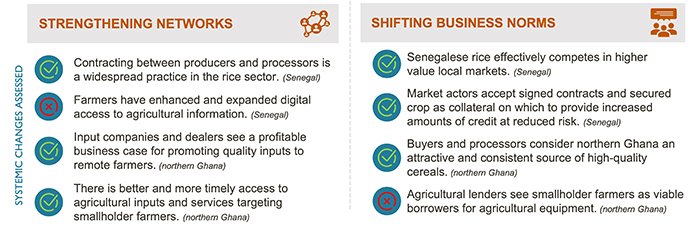
In total, six of the eight systemic changes that were emerging at the time of programme closure across both cases MSP studied (Senegal and Ghana) were enduring at the time of the ex-post studies.
This is notable given that both COVID-19 and the agricultural input price increases caused by Russia’s war in Ukraine occurred over the period being studied. While dips were noted in 2021, both systems bounced back in 2022 and so demonstrated their resilience to these disruptions.
That said, not everything stuck! While the 2024 review observes that funders and programmes often struggle to publicise what hasn’t worked, the ex-posts found that digital information access in Senegal, and agricultural equipment lending in northern Ghana, partially or completely stopped. Not addressing the barriers to a sustainable ag equipment lending model and the high cost and expertise for market actors to maintain custom software platforms respectively impeded facilitating durable change in these areas.
What do these system-level changes mean for the target populations?
Are they still benefiting or have they been left behind?
In both countries more smallholder farmers are being reached now by the project-supported models than at project close. They report strong satisfaction with the programme-supported models and are continuing to use them. Their earnings are on average equal to, or above, those at programme close.
What do these findings mean for funders and implementers?
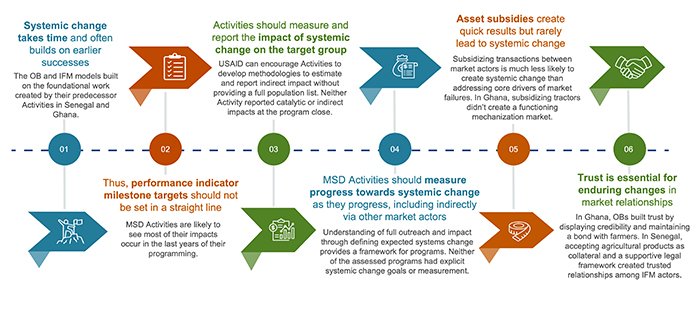
There are many implications, but here are a couple that stand out:
- Systemic change takes time and often builds on earlier successes. Both programmes we studied were in the second phase, so we were looking at changes 13 years following the start of programming.
- Subsidising assets creates quick results but rarely leads to systemic change. The Ghana programme’s significant subsidies for farmers to purchase agricultural equipment resulted in no systemic change, whereas the much less costly support to farmers’ access to input and output markets created lasting results.
Where are we going from here?
There are many more findings than these - and I encourage you to read them for yourself by going to the ex-post landing page, featuring both current and upcoming resources. Whether you’re interested in briefs (Senegal’s is also available in French), full reports or webinars, there’s a format for you to explore.
We encourage funders and implementers to use the tips and takeaways above when guiding their own ex-post research to better understand the long-term impacts of their programming.
If you’d like to hear more about how these ex-post findings have contributed to the most recent 2024 BEAM Evidence Review, please watch the webinar that took place on 5 November 2024:
Add your comment
Sign up or log in to comment and contribute.
Sign up