Impact evaluation
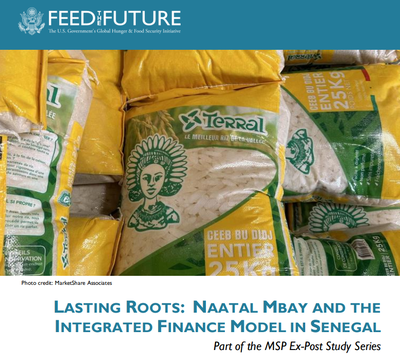
Lasting roots: an ex post study in Senegal of Naatal Mbay and the integrated finance model


- Published by
- USAID Market Systems and Partnerships (MSP)
- Project implementer
- RTI International
- Donor
- USAID
- Programme
- FTF Senegal Naatal Mbay Activity
- Results level
- Poverty reduction
- Method
- Mixed method
- Data source
- Mixed
- Intervention types
- Improved access to finance
- Improved value chain coordination
Ex-post study conducted three and a half years after the close of USAID’s Feed the Future Senegal Naatal Mbay Activity in 2019. It examines the scale and sustainability of changes resulting from Naatal Mbay’s introduction of an integrated finance model (IFM) in the domestic rice sector in Senegal.
The findings show a relatively positive evolution since project closure, with three of the four intended systemic changes enduring over time. The study also offers observations on implications for programming in both Senegal and for global practitioners.
The study focused on four questions:
- What systemic changes were the Activity trying to create, to what extent had these changes been achieved when intervention activity stopped, and which of those have been sustained?
- Has the performance of the system's focus functions been maintained, deteriorated or improved relative to their status at Activity closure?
- Have there been sustained and scaled gains to the ultimate intended target populations as a result of the systemic changes?
- Are there lessons about approaches to implementation that can be learned from the sustainability of outcomes (and the reasons why)?
This study is one in a series of ex-post evaluations that are being conducted between 2023-2026 on USAID-funded MSD interventions around the world.
The report summary is also available in French below:
Intervention description
The Naatal Mbay Activity introduced several interventions to enhance the rice value chain in Senegal, focusing on an integrated finance model (IFM) that connected market actors to secure credit using paddy rice as collateral. The project partnered with financial service providers (FSPs), rice processors, and farmer cooperatives to facilitate this model.
Activities included establishing formal contracts between producers and processors and using third-party holding systems (TPHS) for crop storage. By the end of the programme in 2019, the use of IFM had expanded significantly, with 37 per cent more companies using agricultural products as collateral and a 377 per cent increase in lending across value chains to USD $88.4 million. The partners adopted the new models and practices, leading to a 377 per cent increase in lending across all value chains between 2019 and 2022.
The perception of the project partners was positive, and they intended to continue with the promoted models beyond the project's support.
Evidence methodology
The ex-post evaluation employed the Disrupting System Dynamics (DSD) framework to analyse systemic changes. It used a mix of desk research, 122 key informant interviews, and 26 focus group discussions with rice producer networks in Senegal. The study also included a validation workshop with USAID/Senegal, implementing partner staff, and market actors.
This mixed-methods approach aimed to understand the sustainability and scale of systemic changes catalysed by the Naatal Mbay programme.