Project description / objective
To enhance food security and strengthen coping mechanisms for rural smallholders in the fragile state of South Sudan through a humanitarian-development nexus. The programme specifically aims to improve the food security of 21,826 (54% female) rural smallholders while enabling them to cope with environmental volatility and insecurity.
Market systems focus
Access to ox- plough
Agricultural markets in South Sudan are underdeveloped, limiting farmers' access to quality inputs and fair prices. Local market systems remain weak, with agro-input dealers reluctant to expand beyond hubs like Wau or Rumbek. Humanitarian free input programmes exacerbate dependency and deter local trader engagement.
Financial services
In fragile settings such as South Sudan, households rely on coping mechanisms to manage shocks from climate and conflict, as well as economic instability. Limited access to finance, especially for women, remains a critical barrier, hindering their ability to support families and meet needs.
Programme interventions
Access to ox-plough
Collaboration with agri-input dealers
Partnering with local dealers to promote an innovative business model featuring cost-sharing agreements with 50 per cent subsidies for ox-ploughs, reducing risks for dealers. Strengthened dealer-participant relationships and supply linkages ensured a steady, consistent market supply.
Cultivating smallholder farmer demand
Focus on stimulating farmers’ demand for ox-ploughs by using lead farmers as role models. They demonstrated the benefits and introduced alternative financing options, reshaping perceptions and increasing demand. This encouraged agri-input dealers to stabilise and expand supplies.
Financial services
The Saving for Transformation (S4T) model empowers communities through savings groups, providing access to credit and promoting financial inclusion. This cost-effective, self-replicating approach fosters resilience, poverty reduction, and economic empowerment in areas with limited formal financial services.
Notable results (systemic change, poverty impact)
FORSITE has actively collaborated with five market actors to ensure the availability of enhanced inputs for households, enabling them to significantly increase their agricultural productivity. The evaluation showed a substantial increase in respondents who had accessed inputs for income generation, rising from 38 per cent at baseline to 98 per cent.
A total of 1,565 ox-ploughs were acquired through a 50-50 cost-sharing arrangement, with participants contributing USD $67 each toward the average price of USD $120-150. The programme leveraged a total investment of USD $107,000. This initial access, along with a familiarisation exercise led by lead farmers, sparked increased demand for ox-ploughs which led to further purchases of 610 ox-ploughs without cost-sharing or subsidy.
Survey data showed that 57 per cent of targeted farmers had their own ox-ploughs and occasionally provided ox-ploughing services to community members.
By March 2023, one agro-dealer at Marial Baai, Jur River had sold 610 ox-ploughs since 2020, out of which 130 ox-ploughs were sold to farmers without project subsidy. This is a clear case of demand generation for agricultural input and making agro-input businesses attractive to the private sector.
Following the endline survey, the number of ox-ploughs made available by agro-dealers to farmers increased to 2,300.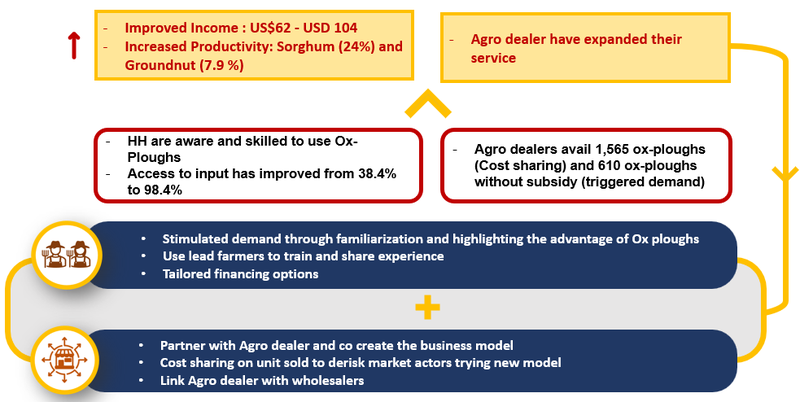
Financial services
A total of 72 S4T groups were established with 1,897 members (1,178 females, 719 male) up from a baseline of zero, surpassing the project target of 1,700 individuals (1,100 Female, 600 male). This represents 112 per cent achievement of the target.
- Cumulative savings on the endline by the 72 S4T groups supported is USD $133,000.
- The sum of loan distributed at the end of the programme period by all the S4T groups is USD $73,000.
- Total loan amount paid back (recovered) is USD $63,000.
- Cumulative social funds accumulated by all the S4T groups is USD $16,000.
Impact on poverty
- 22 per cent reduction in the percentage of households in moderate or severe food insecurity between the final evaluation (30 per cent) and baseline of 52 per cent.
- Quarterly median household income increased to USD $103.9 at final evaluation from USD $62 at baseline. This translates into an increase of USD $41.95 quarterly. In total annual median income of household have increased by USD $168.
- Sorghum yields increased 24 per cent (to 0.66 tonnes/hectare) from baseline.
- Groundnut yields increased 8 per cent (to 0.47 tonnes/hectare) from baseline.
[uploaded January 2025]